The Shadow AI Audit: How to Find Out What Your Team Is Actually Using (And Make It Safe)
Is your UK business at risk? Discover how to run an ethical Shadow AI Audit to find unauthorized tool use, secure client data, and create an ICO-compliant internal AI policy.

Donna Mitchell
Founder · Communications & Change Strategist
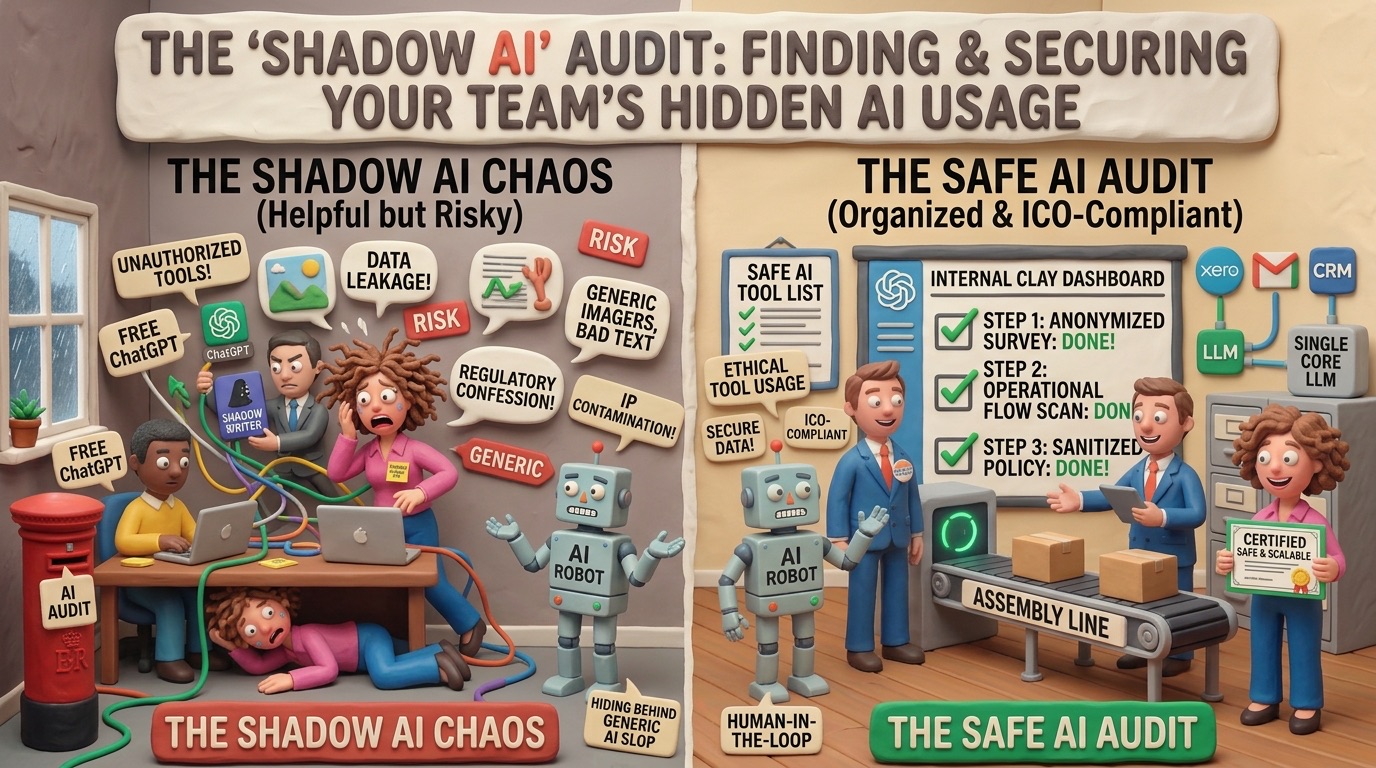
It's 2026. Your staff aren't experimenting with AI anymore, they're relying on it. The question that actually matters isn't whether your team is using AI. It's whether they're using the version you set up, checked, and can stand behind, or whether they've quietly gone and found something faster themselves.
That second version has a name: Shadow AI. Unauthorised, un-vetted tools running underneath your official tech stack, usually the free tier of something, used because it's genuinely quicker than whatever you gave them, or because nobody gave them anything at all.
In legal, finance, accountancy, and for any premium coach or consultant handling sensitive client information, Shadow AI is the single biggest compliance blind spot most small businesses have right now. Not because anyone's being reckless. Because nobody's looked.
This is a management gap, not staff misconduct
I want to be direct about this before anything else, because the instinct when you first hear "Shadow AI" is to feel got at, and it's the wrong instinct. Shadow AI is almost never deployed by someone trying to cut corners. It's deployed by your best people, the ones under enough pressure to get the work out that they'll find a faster way and just quietly use it.
That's a communication and provisioning failure, not a discipline problem. If you haven't told your team which tools are safe, given them access to one, and explained why it matters, you've left a gap, and high performers fill gaps. This sits squarely inside what I call
Team Mindset readiness, the AI-readiness pillar most businesses skip. Punishing the symptom without fixing the gap just pushes the same behaviour further underground.
The three risks Shadow AI actually creates
1. Direct data leakage
A team member pastes a client contract, a financial statement, or a case file into a free, public LLM to get a quick summary. Depending on that tool's terms, and on the free tier of most consumer AI products, that input can be used to train the model. Once commercially sensitive or personal data has gone into a system you don't control and can't retrieve it from, there is no clean way to undo it.
2. A regulatory confession you didn't mean to make
Under UK data protection law, you're responsible for how personal data is processed, including automated processing, even when the tool doing the processing was never approved, provisioned, or known about by you. If a member of staff feeds client personal data into an unvetted tool, that's your compliance exposure, not theirs, whether or not anyone in the business signed off on it.
3. Intellectual property you don't actually own
Novel strategy, pricing logic, a methodology you've spent years refining, run through a free tool to "tidy it up" or summarise it, and the output sits inside a system whose terms you never read. Depending on the tool, you may not hold clean rights to what comes back out, which is a strange way to find out your own thinking isn't fully yours anymore.
Shadow AI isn't a discipline problem. It's what happens when speed has no safe outlet.
The Shadow AI Audit: three steps, one weekend
The goal here isn't a witch hunt. It's visibility, done in a way that doesn't make your best people defensive. Three passes, each one looking at a different layer of the business.
Step 1: the anonymised survey, your team
Build a short, genuinely anonymous survey, Make.com, Google Forms or Microsoft Forms all work, and frame it honestly: "Helping us choose better tools", not "Reporting unauthorised use". Ask which AI tools people use daily, which they've used weekly, and which they've "just tried once". Anonymity matters here more than almost anywhere else in the business, because the accuracy of every later step depends on people telling you the truth in step one.
Step 2: the operational flow scan, your systems
Review every live automation and integration across the business, the same audit we described in
Why Most Small Businesses Waste Money on AI Tools, but this time you're not hunting for waste, you're hunting for exposure. Look specifically for connections to LLMs you don't recognise, and for cheap, single-purpose AI apps sitting on a company card that nobody remembers approving. These are usually the clearest evidence of Shadow AI you'll find, because someone had to actually pay for them.
Step 3: the device review, only if you're clearly entitled to run one
If your business owns the device and your employment contracts and IT policy already cover it, a review of installed apps on company hardware is the most direct way to see what's actually running. If you're not certain your contracts cover this, don't guess, take proper employment law advice before you look at anyone's device. Getting this step right matters more than getting it done fast.
From discovery to a policy nobody's afraid of
The point of the audit isn't a ban. A blanket "no AI" policy just pushes Step 1's honest answers back underground, and you lose the productivity your team already found for you. The actual outcome should be a short, plain-English internal AI policy, built from what the audit found.
The Safe List, use these
- →Whichever paid, business-tier plan you've already chosen, ChatGPT Business or Enterprise, Claude for Work or Team, Gemini for Workspace, or Copilot, not the free consumer version.
- →Data training switched off in the admin settings. This is usually one toggle, and most businesses running the free tier have simply never found it.
- →One approved tool per task type, not five competing options nobody standardises on.
The Never List, strict prohibitions
- →Never paste unmasked client personal data, names, contact details, case or account numbers, into any tool outside the Safe List.
- →Never upload a commercial contract, financial statement, or client file to a free or unapproved system, even "just to summarise it".
- →Never treat an AI-generated output as final. Every one gets a human before it leaves the building.
The human-in-the-loop clause
Every AI-assisted output, a drafted email, a summarised contract, a client-facing document, gets reviewed and approved by a person before it goes anywhere. It's the same simple rule we set out in the AI-readiness pillars: AI drafts, a person approves. That one sentence, written down and actually enforced, closes most of the risk on its own.
This is exactly the work we do
If you run a legal practice, an accountancy, a financial advisory, or a premium coaching or consulting business handling sensitive client information, this audit sits at the centre of what we mean by operational trust, not a feature bolted onto a bigger project, the actual foundation an AI strategy has to stand on before anything else gets built.
We run this exact audit, the anonymised survey, the operational flow scan, and where appropriate the device review, as part of our AI Strategy & Audit work, and we scope the resulting policy to your sector's specific risk, not a generic template pulled off the internet.
Worried about what AI tools your team is secretly relying on? Book a private internal AI security call with our team, and let's structure an ethical audit that protects your business.Book your free discovery call →Not ready to talk yet? Take the free AI Readiness Audit →See how a private context layer looks in practice →
Frequently Asked Questions
What is a Shadow AI audit?
A Shadow AI audit is a structured, ethical review of every AI tool actually in use across your business, official and unofficial, so you can see where sensitive data might be exposed and build a policy that closes the gap without banning AI outright. For a small business, it's three passes: an anonymous staff survey, a scan of live automations and integrations, and, only where clearly permitted, a review of company device installations.
How do I create a UK internal AI security policy?
Start from what your Shadow AI audit finds, not a generic template. A working policy has three parts: a Safe List of approved, business-tier tools with data training disabled, a short list of strict prohibitions covering unmasked client data and commercial documents, and a human-in-the-loop clause requiring every AI output to be checked by a person before it's used.
What's the biggest risk from managing Shadow AI badly in the UK?
The three that matter most are direct data leakage into public tools that may train on your input, inadvertent breaches of your UK data protection obligations around personal data processing, and losing clean intellectual property rights over strategy or methodology run through a tool whose terms you never read.
Is Shadow AI a GDPR or ICO compliance issue for small businesses?
Yes, in most cases. Under UK data protection law, you're accountable for how personal data is processed even when the processing tool was never approved or known about by you, which means an employee's undisclosed use of a public AI tool on client data becomes the business's exposure, not just theirs.
Should I ban AI tools if I find Shadow AI in my business?
No. A blanket ban just pushes the same behaviour underground and loses you the productivity gains your team already found. The better move is provisioning one approved, business-tier tool per task, disabling data training, and writing a short policy your team can actually follow, built from what the audit tells you they're already doing.
Can I legally check what AI apps are installed on company devices?
Only if your employment contracts and IT policy already give you that right, and the specifics vary by business and by how the device is used. Don't assume, take proper employment law advice before reviewing any device, and treat the anonymous team survey and the systems scan as your primary audit tools regardless.
Get The Brief by email
One AI tool, one tip, one insight for small business owners. Free, every week.
Found this useful? Share it