Why Most Small Businesses Waste Money on AI Tools
UK small businesses stack five or six single-purpose AI apps and spend £200 to £500 a month for it. The fix isn't better tools, it's designing the workflow before you buy anything.

Donna Mitchell
Founder · Communications & Change Strategist
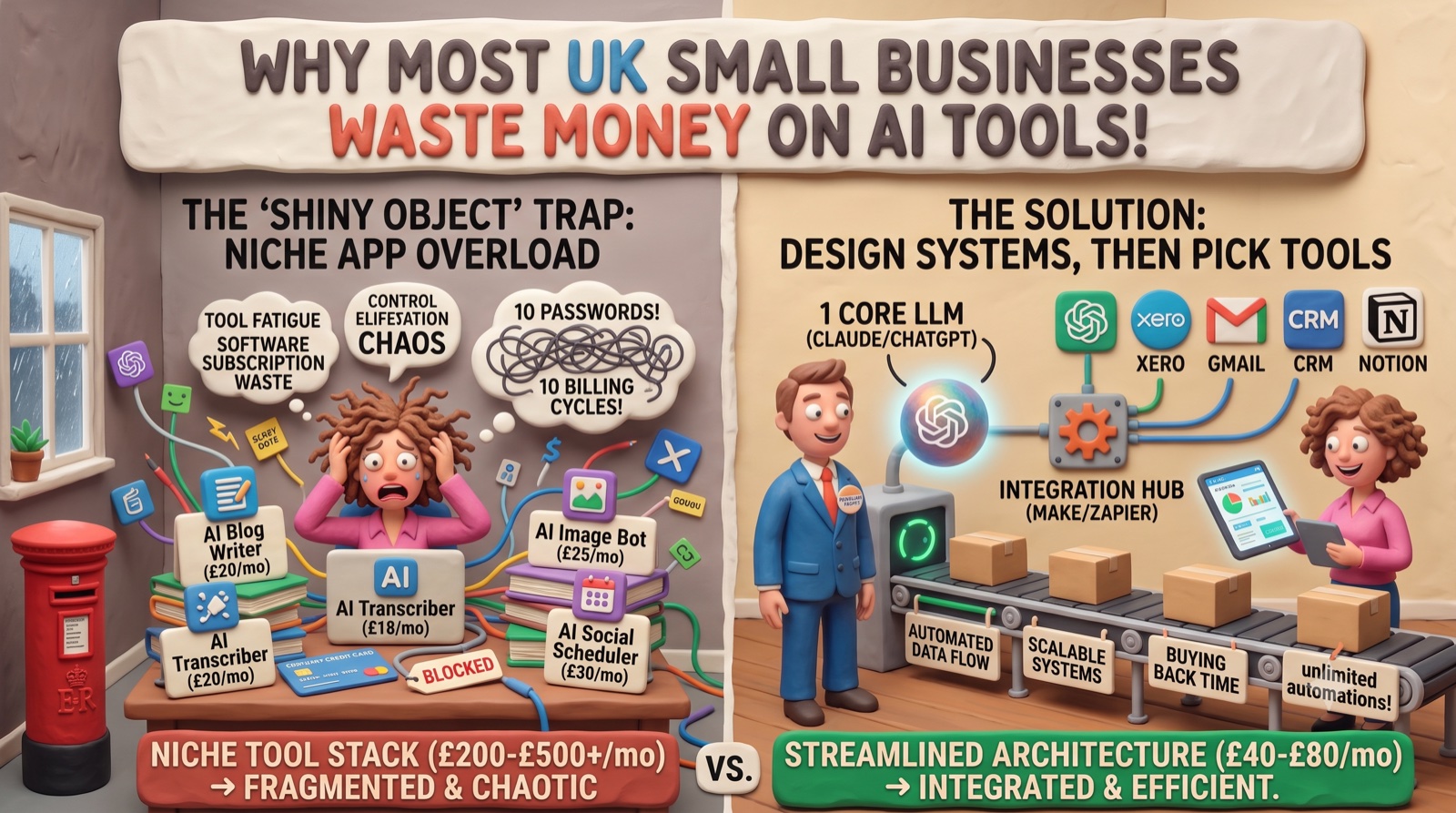
Check your company credit card statement. Between the software renewals and cloud storage fees, you will spot a pattern: £20 for an AI writing assistant, £18 for a transcription service, £25 for an image generator, and £30 for a social scheduler nobody on your team has opened since last month.
It adds up quietly, and it adds up fast.
Thousands of UK small business owners are caught in the same loop. They sign up for tools because a LinkedIn post made it look easy, stack five or six subscriptions on top of each other, and end up spending hundreds a month while the actual operational problems stay exactly where they were. The industry has a name for it: AI tool fatigue. The fix has nothing to do with finding better tools.
Your business does not have an AI tool problem. It has a system design problem.
You bought software before you mapped the workflow
This is the root of it. The tool is not the issue. The sequence is.
It plays out the same way every time. You see a demo of something that writes sales emails in five seconds. You sign up for the £20 a month plan. You try it on real work, and it does not match your tone, does not know your product range, and does not connect to your CRM. You go back to doing the task manually because fighting the tool takes longer than the task itself. Then you forget to cancel the subscription, and it sits on your direct debit for the next eight months doing nothing.
Stack five or six of these on top of an already messy operational foundation and what you get is fragmented data, confused staff, and subscription waste. Not efficiency. The opposite.
Here's the thing.
Never buy software to figure out a process. Figure out the process first, then select the minimum software you need to run it.
Consolidate your stack and design the system first
To get a real return from AI, flip the buying sequence. Instead of collecting ten single-purpose apps, build one integrated workflow.
The difference looks like this. A niche tool stack of ten separate AI apps runs £200 to £500 a month. Data sits in silos. Staff copy and paste between interfaces. Nobody remembers the passwords. A consolidated setup, one commercial-tier language model like Claude or ChatGPT Plus connected through a single integration engine like Make or Zapier, runs £40 to £80 a month and does more, because the data flows through the tools you already pay for.
Two moves make it work.
Anchor everything around one core AI engine.
Instead of paying separate subscriptions for a blog writer, an email drafter, an internal search tool and a customer support bot, invest in one good language model. Modern commercial models handle draft creation, data analysis, document summarisation and process planning in a single interface. Your team learns one tool instead of five.
Connect what you have with a single integration engine.
Rather than buying niche apps that claim to sync with your software, use Make or Zapier as the bridge between your core AI and the platforms already running, Xero, HubSpot, Gmail, Notion. The integration engine becomes the link between systems. One control point, one place to fix when something breaks.
A 30-minute AI subscription audit
If you want to free up cash this week, run this.
Pull your last two bank statements and mark every recurring software charge under £50. Then ask your team one question: has anyone used this tool to complete an actual piece of work in the past fourteen days? If the answer is no, cancel it. Do not downgrade, do not pause, cancel. You will not miss it.
Next, identify the single task that eats the most human hours every week. Not the most interesting one, the most repeated one. Turning sales calls into proposals, chasing late invoices, formatting reports for clients, whatever it is. Map that process on paper, step by step, before you open a single piece of software. Only then decide whether you need an integration to connect the dots.
The order matters. Process first, then tool. Every time.
Stop renting apps and start building assets
The point of automation is not to collect subscriptions. It is to build systems that buy back your time and hold value when you are not in the room.
At BrightMind Studio, we work as independent advisors. We do not sell software licences, and we do not push apps. We review your existing tech stack, cut the subscription waste, and design integrated workflows connecting the tools you already use.
If you want to stop paying for software nobody opens, book a free discovery call and we will map where the money is going and what to do about it. Or run the Revenue Leak Detector yourself; it takes three minutes, and it will show you the number before we speak.
Book your free discovery call →Run the Revenue Leak Detector →Get The Brief by email
One AI tool, one tip, one insight for small business owners. Free, every week.
Found this useful? Share it