What an AI Consultant Costs in the UK (2026 Prices)
UK AI consultants charge £500 to £1,500 a day. Small business projects run £750 to £15,000. Real pricing bands, hidden costs, and how to scope so you pay less.

Carl Grant
BrightMind Studio
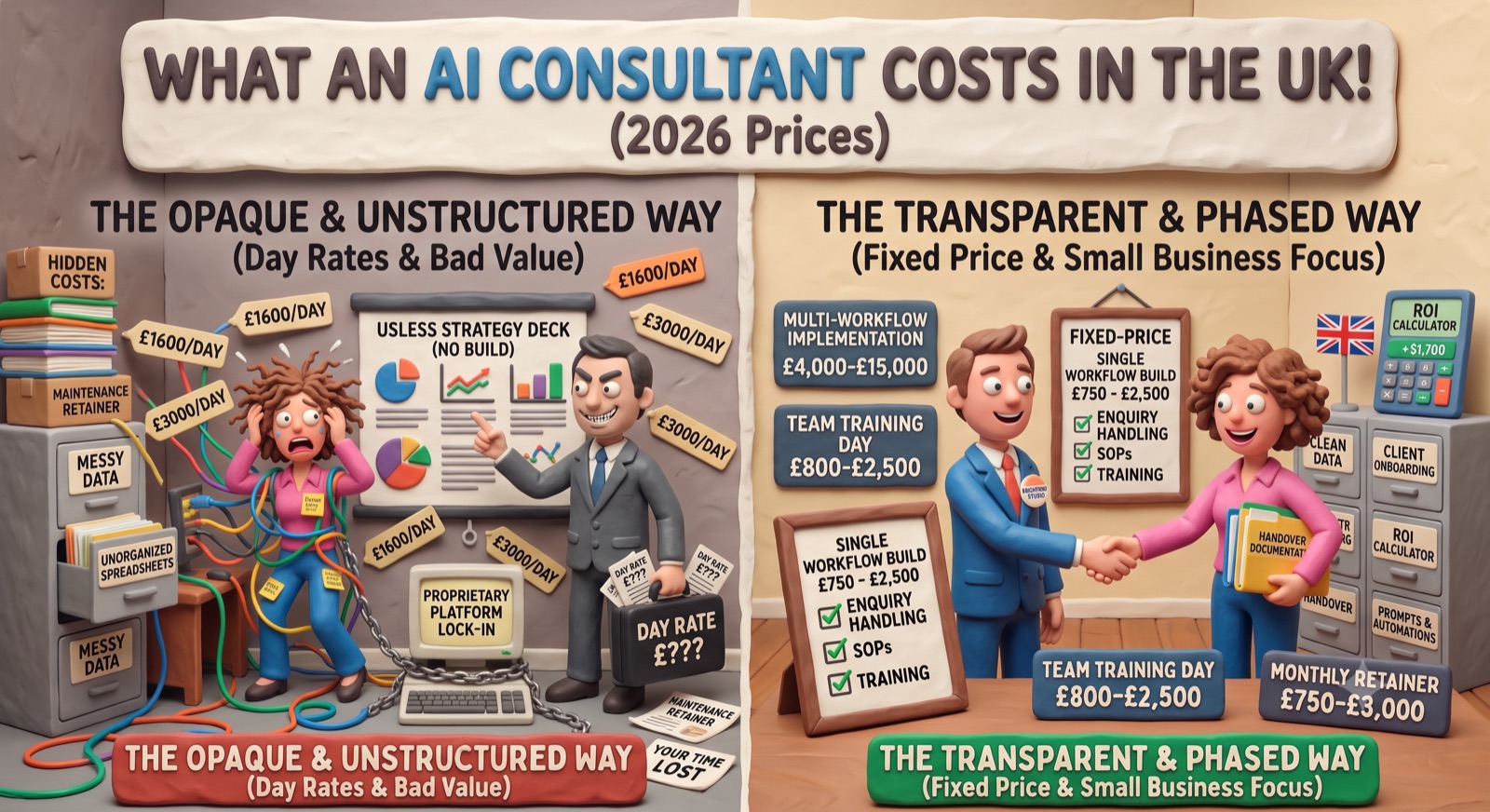
UK AI consultants charge between £500 and £1,500 per day in 2026. A small business project with a fixed scope runs £750 to £15,000 depending on how many workflows you change. Monthly retainers sit between £750 and £3,000. Where you land inside those ranges comes down to three things: the state of your data, how many systems need connecting, and whether you are buying advice or advice plus the build.
Most pricing pages stop at "it depends". This one gives you the numbers, the drivers behind them, and the shape of an engagement worth walking away from.
Why the ranges look so wide
Search the term and you will find guides quoting £500 a day and others quoting £3,000. Both are correct, because they describe different markets.
Independent consultants working with owner-managed businesses sit at the lower end, roughly £500 to £1,200 a day, or £80 to £200 an hour. Small agencies and boutique studios sit between £950 and £1,500. Mid-tier consultancies run £900 to £1,600. Big Four and enterprise firms start around £2,000 and climb past £3,000, with programme costs for a mid-sized company reaching six figures.
Specialisation moves the number again. Guides published this year put a 25 to 50 percent premium on generative AI and language model work, and a similar uplift for regulated sectors like financial services and healthcare, where compliance knowledge is scarce.
So if you run a business with fewer than twenty people, most published figures you find online describe a market you are not shopping in. The relevant range for you is narrower, and the rest of this article stays inside it.
What you get at each price band
AI opportunity review, £500 to £2,000
One to two days of assessment. Workflow mapping, tool recommendations, a prioritised list of where AI saves time. No build. Suits owners wanting direction before spending.
Single workflow build, fixed price, £750 to £2,500
One process solved end to end, integrated with software you already use, with a short handover doc. Suits first-time buyers testing whether this works.
Multi-workflow implementation, £4,000 to £15,000
Three to six workflows, system integrations, team training, SOPs, and post-launch support. Suits businesses ready to change how they operate.
Team training day, £800 to £2,500 per day
Live session, role-specific use cases, prompt library, follow-up materials. Suits teams of five plus with tools already in place.
Ongoing retainer, £750 to £3,000 per month
Priority access, monthly reviews, iteration on live systems, new automations as they surface. Suits businesses with systems running and appetite to extend.
Enterprise programme, £25,000 and up
Full transformation scope, data infrastructure, governance. Suits organisations with an internal IT function.
The band worth paying attention to is the second one. A fixed-price first project with one clearly defined problem is the cheapest way to find out whether a consultant is worth their fee. If someone will not quote fixed for a single workflow, ask why.
The four pricing models, and which one protects you
Day rate.
Clean and simple. Risky for you, since the meter runs whether or not the work lands. Suits advisory and training, poor for builds.
Fixed-price project.
The consultant absorbs the risk of the work taking longer. Best model for small businesses by a distance. Requires tight scope on both sides.
Monthly retainer.
Good once systems are live and need maintenance. Bad as a starting point, because you pay for access before anyone has proven value.
Outcome or percentage-based.
Rare, and usually a warning sign for a business your size. Attribution gets messy and the arguments start at month three.
Start fixed. Move to retainer once something is running and earning.
Six things pushing your quote up
The state of your data does more to your price than anything else. Records spread across three tools, inconsistent naming, half a CRM and a spreadsheet, all of it turns a two-day build into a five-day one. Enterprise pricing guides put data preparation at 40 to 60 percent on top of the original budget, and the same principle scales down.
Integration count matters next. One tool to one tool is straightforward. Five systems talking to each other with conditional logic between them is a different job.
Headcount for training follows. Building for one owner is quick. Rolling out to twelve people across three roles needs documentation, sessions, and a follow-up cycle.
Regulated sector work adds 20 to 35 percent, because the consultant carries risk and the scoping takes longer.
Custom build versus configuration is the big fork. Connecting tools you already pay for costs a fraction of building something bespoke. Most small businesses need the former and get sold the latter.
Urgency prices in too. A four-week deadline reorders someone's calendar, and you pay for the reordering.
The costs nobody puts in the quote
Tool subscriptions sit outside most consulting fees. Budget £50 to £300 a month for the stack behind a working automation.
Maintenance is next. Systems drift. APIs change, a tool updates its interface, someone leaves and takes the process knowledge with them. Set aside a few hundred a year or a light retainer.
Then there is your own time. Every good implementation needs the owner in the room for the mapping stage. Two to four hours of your week for the first month is realistic, and any consultant promising zero involvement is selling you something with your name on it and nothing of your business inside it.
What bad value looks like
- →A strategy deck with no build attached. Forty slides, a maturity model, and a recommendation to start a working group. You are a small business, not a bank.
- →Per-seat tool reselling dressed as consultancy. If the fee scales with licences rather than work delivered, check whose interest is being served.
- →No handover documentation. If the system stops working the week the consultant stops answering emails, you rented a result rather than buying an asset.
- →Scope written entirely in outcomes with no listed deliverables. "AI transformation across your operations" is not a scope. "Three automations across enquiry handling, proposal drafting and invoice chasing, with SOPs and one training session" is.
- →Lock-in to a proprietary platform you do not control. Ask where the automation lives, who owns the account, and what happens if you end the relationship.
The project we turn down
A business came to us wanting a chatbot for their website. Their site took around forty enquiries a month, and every one was answered by the owner within the hour. Automating that would have saved perhaps ninety minutes a week and removed the one part of the process customers liked.
The real problem sat further back. Their proposals took two days to write and around a third never got sent. We said no to the chatbot and quoted for the proposal workflow instead, at a lower price than the original brief.
A consultant who quotes for whatever you asked for is easier to work with and worse for your business. The first honest conversation should involve at least one thing being removed from your list.
How to scope so you pay less
- →Pick one workflow with a time cost you already know. Not the most interesting one, the most repeated one.
- →Ask for a fixed price on the first piece of work, and treat any refusal as information.
- →Ask what you own at the end, in writing. Accounts, documentation, prompts, automations.
- →Ask what happens after handover, and get the support window in the contract.
- →Set a 90-day review with a number attached. Hours saved, turnaround reduced, enquiries handled. If the number is absent at 90 days, stop and reassess before spending more.
What doing nothing costs
Twenty hours a week on repetitive admin at a blended £35 an hour works out around £2,184 a month, or £26,208 a year. Against those figures, a £2,500 first project pays for itself inside six weeks, assuming it removes even a third of the load.
Run your own version of that sum before you speak to anyone. Our ROI calculator does it in about three minutes, and it will tell you whether this is worth your time at all.
Run the numbers on the ROI Calculator →Next step
Every BrightMind engagement starts with a free 45-minute discovery call where we map where AI helps you and where it wastes your money. No deck, no pressure.
Book your free discovery call →Not ready to talk to anyone yet? Take the free AI Business Audit. Ten questions, a readiness score across five areas, and a set of next steps you own whether or not you work with us.
Take the free AI Business Audit →Our pricing is published in full, and our case studies show what these numbers bought for four real businesses.
See our published pricing →Read 4 real case studies →Frequently Asked Questions
How much does an AI consultant cost for a small business in the UK?
Most small business engagements run £750 to £15,000. A single fixed-price workflow build sits at £750 to £2,500. A multi-workflow implementation with training and handover runs £4,000 to £15,000. Day rates for independents and small studios fall between £500 and £1,500.
Is a freelance AI consultant cheaper than an agency?
Usually, at £500 to £1,200 a day against £950 to £1,500 for a small agency. The trade-off is capacity and cover. A freelancer gives you direct access to the person building the work. An agency gives you continuity when that person is unavailable.
How long does a small business AI project take?
A single workflow build takes one to three weeks from scoping to handover. A multi-workflow implementation runs six to twelve weeks, with most of the calendar time spent waiting on decisions and access rather than on the build itself.
What hidden costs should I budget for with AI consulting?
Tool subscriptions of £50 to £300 a month, data tidying before any build starts, ongoing maintenance, and your own time during scoping. Data preparation is the one people underestimate most, adding up to 60 percent on projects with messy records.
Should I pay for an AI consultant discovery call?
No. A first conversation to establish fit should be free. Paying starts when someone produces work you keep, whether an assessment, a roadmap or a build. Charging full rate for discovery with no output you own is a red flag.
How do I know whether an AI consultancy quote is fair?
Compare deliverables, not day rates. Ask what you own, what happens after handover, and what the consultant would remove from the scope if the budget dropped by a third. The answer to the last question tells you more than the price does.
Get The Brief by email
One AI tool, one tip, one insight for small business owners. Free, every week.
Found this useful? Share it