What "AI-Ready" Actually Means for a Small Business in 2026
AI readiness has nothing to do with prompts or software subscriptions. Donna breaks down the five operational pillars that decide whether AI actually helps your business, or just adds to the chaos.

Donna Mitchell
Founder · Communications & Change Strategist
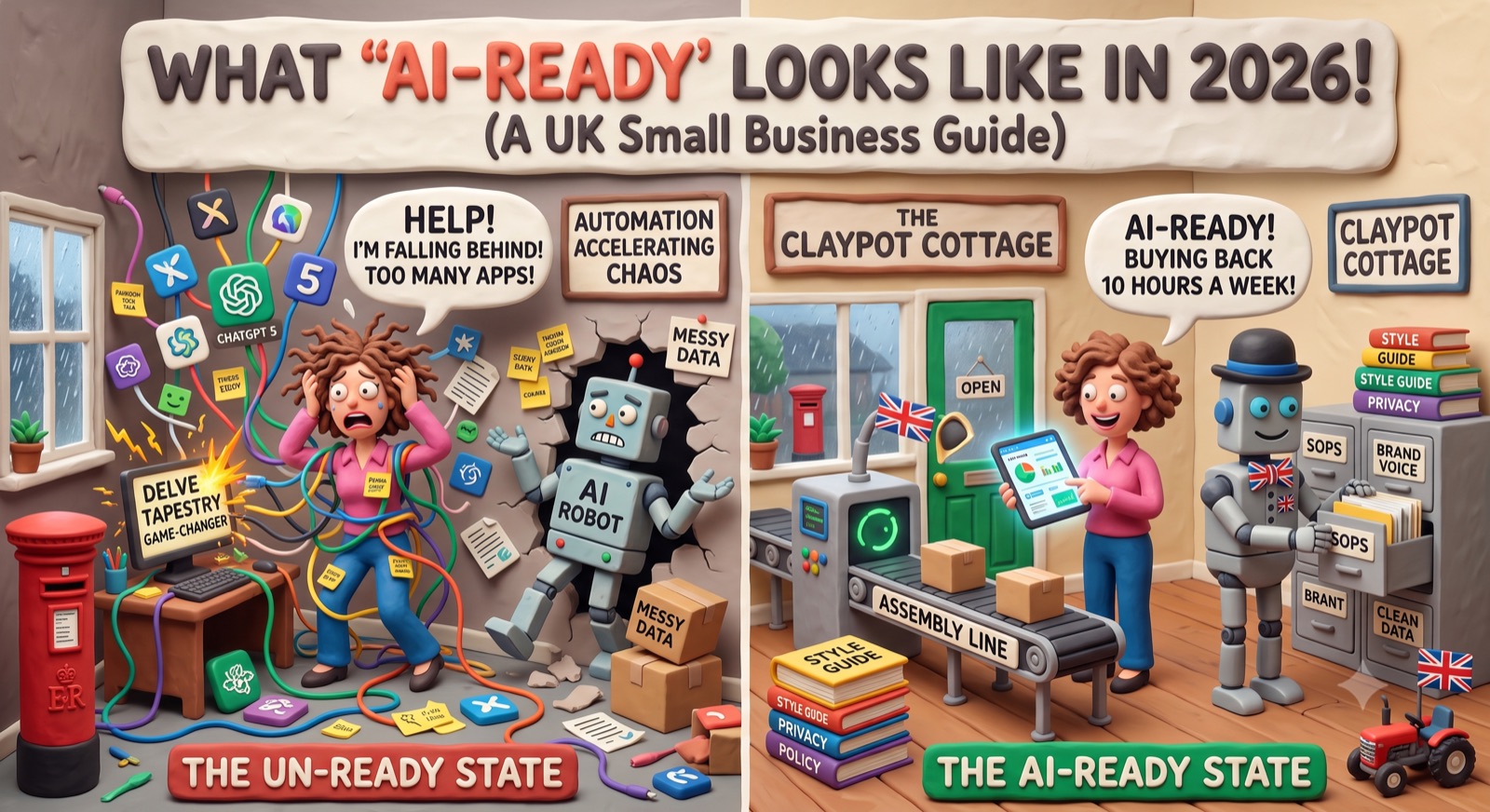
I've spent fifteen years helping organisations communicate through change, and the pattern I keep seeing with AI is the same one I recognise from every digital transformation before it. The businesses that struggle aren't short on ambition or budget. They're short on readiness, the unglamorous groundwork that decides whether a new system actually lands, or just adds another layer of disruption.
If you feel like you're falling behind on AI, here's the reassurance worth hearing first: being "AI-ready" has almost nothing to do with writing code, mastering clever prompts, or subscribing to ten different £20-a-month tools you'll use twice.
Most owners are told that getting into AI means a total technology overhaul. It doesn't. Modern AI models are already remarkably capable. The real bottleneck isn't the technology, it's how prepared your business is to hand that technology clear, structured context to work with.
Being AI-ready simply means your operational house is in enough order that automated systems can actually help you, rather than add to the chaos. Here's the honest, practical breakdown of what that looks like for a UK small business in 2026, along with a scorecard you can use to audit your own business today.
The Five Pillars of Genuine AI Readiness
None of these require new software. They require some clear thinking, captured once and reused for good.
1. Process Hygiene: You Can't Automate a Broken System
AI is an amplifier. Feed it a clear, well-considered process and it multiplies your efficiency. Feed it a messy, inconsistent workflow and it simply speeds up the confusion. Before you introduce any AI or automation, you need standard operating procedures your business can actually stand on.
The unready state
Tasks get done differently depending on who handles them, held only in the founder's head or scattered across old email threads.
The AI-ready state
Core workflows, how you onboard a client, draft a proposal, or handle an enquiry, follow repeatable steps that can be documented, mapped, and handed to a system with confidence.
2. Brand Voice Clarity: Giving the Machine Your Accent
The biggest complaint about AI writing is that it sounds flat and generic, stuffed with the same overused words: delve, tapestry, game-changer. That isn't because AI is bad at writing. It's because it was never given anything to sound like.
The unready state
Relying on a bare prompt like "write a blog post about our service" and hoping for the best.
The AI-ready state
A written style guide sets out your tone of voice, the phrasing you actually use, who you're speaking to and what keeps them up at night, and a clear list of the words your business never touches.
3. Data Hygiene and Privacy: Organising the Virtual Filing Cabinet
AI works entirely from the context you give it. If client notes are scattered across WhatsApp, a half-used Notion page, a forgotten Google Doc, and a sticky note, an AI assistant has nothing solid to learn from. And in the UK, that's before you consider your obligations under ICO guidance on handling customer data.
The unready state
Client information stored haphazardly, sensitive personal detail dropped into public AI prompts without a second thought.
The AI-ready state
Centralised, tidy records, and a team that knows which tools and environments are actually safe for commercial use.
4. Team Mindset: AI as a Co-Pilot, Not a Threat
This is the pillar closest to my own work, and the one businesses skip most often. Buying AI tools for a team that's anxious about them, or simply doesn't understand them, is money spent on software nobody opens. Readiness here is about people and communication as much as it is about technology. Every successful change I've supported has depended on this far more than the tool itself.
The unready state
Staff worried the tools exist to replace them, or quietly sticking to the old manual way regardless of what gets rolled out.
The AI-ready state
Clear internal guidelines that frame AI as an assistant, not a threat. Your team understands the simple rule: AI drafts, a person approves, and that confidence is what lets them actually experiment.
5. Tool Stack Consolidation: Less Software, More Strategy
More tools rarely means more efficiency. The businesses that get the most from AI aren't running twenty niche apps. They're running a tight, joined-up stack, usually one or two core AI models and a reliable way of connecting them to everything else.
The unready state
A credit card statement full of single-use subscriptions that never talk to each other.
The AI-ready state
A connected system where your core tools, your CRM, your accounts, your email, can actually pass information between each other.
The Ten-Point AI Readiness Scorecard
Score yourself honestly. One point for every genuine yes.
- →Documented SOPs. Your top three daily administrative processes are written down, step by step.
- →Centralised knowledge. Your service details, pricing, and FAQs live in one searchable place, not scattered across a dozen documents.
- →A written brand style guide. Tone, values, and preferred language are set out clearly enough that someone else could follow it.
- →A clear ideal client profile. You could describe your target client's specific pain points to a stranger in under a minute.
- →Clean customer data. Your contact records are up to date and properly segmented.
- →Privacy awareness. Your team knows never to put confidential client data or passwords into a public AI tool.
- →A standardised tool stack. Your CRM, accounting, and project management tools offer proper integrations.
- →Team buy-in. You've actually talked to your team about how AI can buy them back time, not replace them.
- →A human-in-the-loop policy. Every AI-assisted output is reviewed by a person before it reaches a client.
- →A clear priority. You know, specifically, which bottleneck is costing you the most time or money right now.
What your score actually means:
8 to 10 points
You're in a strong position to implement custom AI workflows and bespoke assistants that pay for themselves quickly.
5 to 7 points
Your foundations are solid, but a handful of operational gaps are worth tidying up before you invest heavily in automation.
0 to 4 points
Start with process and data hygiene. Installing AI on top of an unready business only automates the bottleneck you already have.
Getting AI-ready isn't an overnight technical transformation. It's an operational and cultural shift, and it pays off across every corner of the business long before you deploy your first automation.
This is exactly why we built BrightMind the way we did: done-with-you, not done-and-gone. If you scored under eight, or you'd simply value another pair of eyes on your processes, your brand context, and a realistic implementation plan, that's precisely the conversation an Audit is for.
Book an AI & Operations Audit →Get The Brief by email
One AI tool, one tip, one insight for small business owners. Free, every week.
Found this useful? Share it