The Weekend Edition: How a Boutique UK Consultant Could Reclaim 15 Hours of Admin a Week With Context Layering
A composite scenario, not a single verified client, but a bottleneck we see constantly in boutique UK consultancies: a founder capped not by expertise, but by how long it takes to turn a discovery call into a proposal.

Donna Mitchell
Founder · Communications & Change Strategist
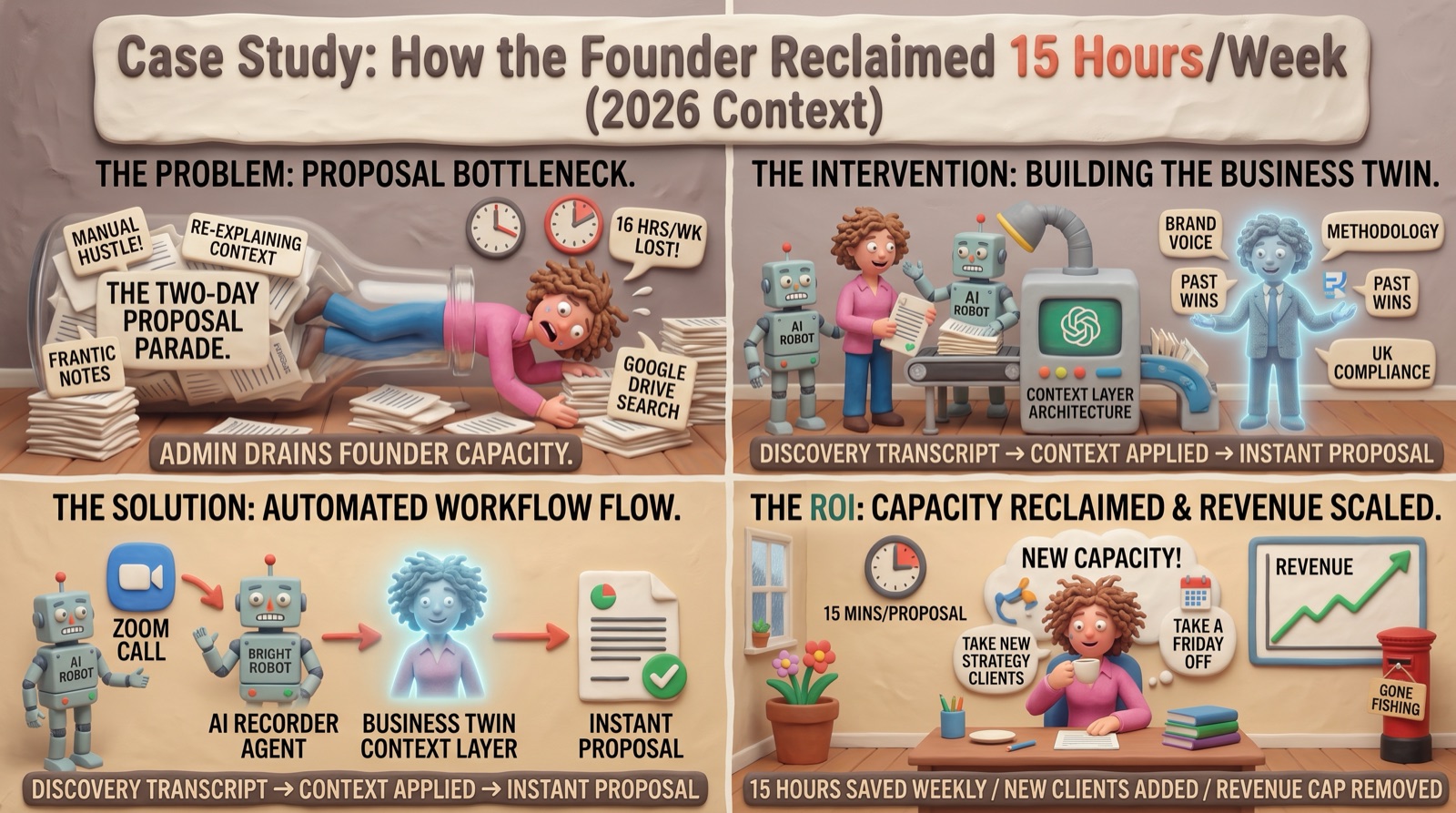
The scenario below is a composite, built from the pattern we see again and again across boutique UK consultancies. The exact numbers belong to no single client, but the bottleneck is one most high-ticket consultants will recognise immediately.
By now, most small business owners have tried ChatGPT, played with a niche writing tool or two, and maybe set up a basic automation. But for boutique strategy consultants, the ones charging high-ticket fees for genuinely specialised expertise, AI tends to hit a ceiling fast. It can write a generic blog post. It cannot write a bespoke client proposal in your voice, matched against your own win rate, referencing your specific methodology.
A change management consultant running his own practice in London came to us drowning in exactly the manual hustle we wrote about in
5 Signs Your Business Needs Systems, Not More Hustle. Demand for his work was strong. His admin was the ceiling on it.
The bottleneck: two days per proposal
His most expensive bottleneck was proposal writing. A qualified lead landing in his inbox wasn't good news exactly, it was the starting gun on a two-day documentation cycle.
- →Discovery call: 60 minutes on Zoom, taking frantic handwritten notes.
- →Transcription: another 60 minutes rereading a messy auto-transcript trying to reconstruct what actually mattered.
- →Context assembly: manually digging through old proposals scattered across Google Drive for a methodology section that roughly fit this client's problem.
- →Custom drafting: 4 to 5 hours rewriting the scope in his own voice and adding pricing, deliverables and standard UK contract terms by hand.
That's roughly 8 hours of founder time per proposal. At two proposals a week, his admin load alone was pushing 16 hours, before he'd done a single hour of billable work. He was turning away business, not because the expertise wasn't there, but because there wasn't enough of him left to write another proposal.
His revenue was capped by his typing speed, not his expertise.
What we actually did: audited the context, not the app stack
We didn't sell him another £20-a-month writing tool, and we didn't point him at whatever AI app was trending that week. We ran an AI and operations audit aimed squarely at his single most expensive point of friction.
The process audit
We mapped his lead-to-proposal cycle step by step, on paper, marking every point where he was manually re-explaining context he'd already given the business once before.
The architecture
No new niche apps. We connected the tools he already used and trusted, Gmail, Zoom, Xero and his CRM, into one workflow.
The context layer
The real bottleneck wasn't typing speed. It was re-explaining the same context to a blank prompt box every single time. So we built him a private context layer, the same idea behind our own
Business Twintool: an AI project trained only on his own material, not the open internet. His signature change-management framework. His written brand guidelines. Five of his strongest, highest-win proposals from the past two years. Standard UK compliance terms and delivery structure. Once that was in place, the AI understood how he actually structures value, before he ever typed a prompt.
The new workflow: discovery call to proposal in 15 minutes
Today, his lead-to-proposal process looks nothing like it did.
- →He records the discovery call (with consent) using an AI meeting assistant, and takes no notes at all.
- →Ten minutes after the call ends, an automation feeds the cleaned transcript straight into his context layer.
- →He opens his private AI workspace and asks it to review the transcript against his context layer and proposal standards, and draft a bespoke proposal for this client's budget and complexity.
- →The AI drafts a full proposal in under three minutes, in his tone, referencing his own track record, structured the way he actually delivers. He spends 15 minutes reading, polishing, and sends it.
What this kind of context layering is worth
Run against the numbers our own
ROI Calculatorproduces for a founder in his position, the shift is substantial.
- →Around 15 hours reclaimed a week, the equivalent of two full admin days back on the calendar.
- →Proposals out within 24 hours of the call instead of three days later.
- →Sharper, more personalised proposals, because the AI is matching the client's stated problem against a context layer of what has actually won before.
- →Capacity for two more high-value clients at once, not more sleep, an actual lift on the revenue ceiling.
You go from manual, brute-force hustle to acting as the system's architect. Context layering doesn't just automate the admin, it lets you sell your expertise at scale.
Could this solve your bottleneck?
Hustle isn't a strategy. Being able to hand AI your own context, automatically, is closer to one. If you're a high-ticket UK consultant, creative founder or boutique agency owner whose capacity is capped by manual documentation, this is exactly the kind of problem we work on.
See what manual admin is costing you with the ROI Calculator →Book a Signature discovery call →Get The Brief by email
One AI tool, one tip, one insight for small business owners. Free, every week.
Found this useful? Share it