Your Bank Statement Is Trying to Tell You Something
Twelve months of transactions sit in your banking app right now. Here's one AI prompt that finds the £2,000+ leaking out every year without you noticing.

Carl Grant
BrightMind Studio
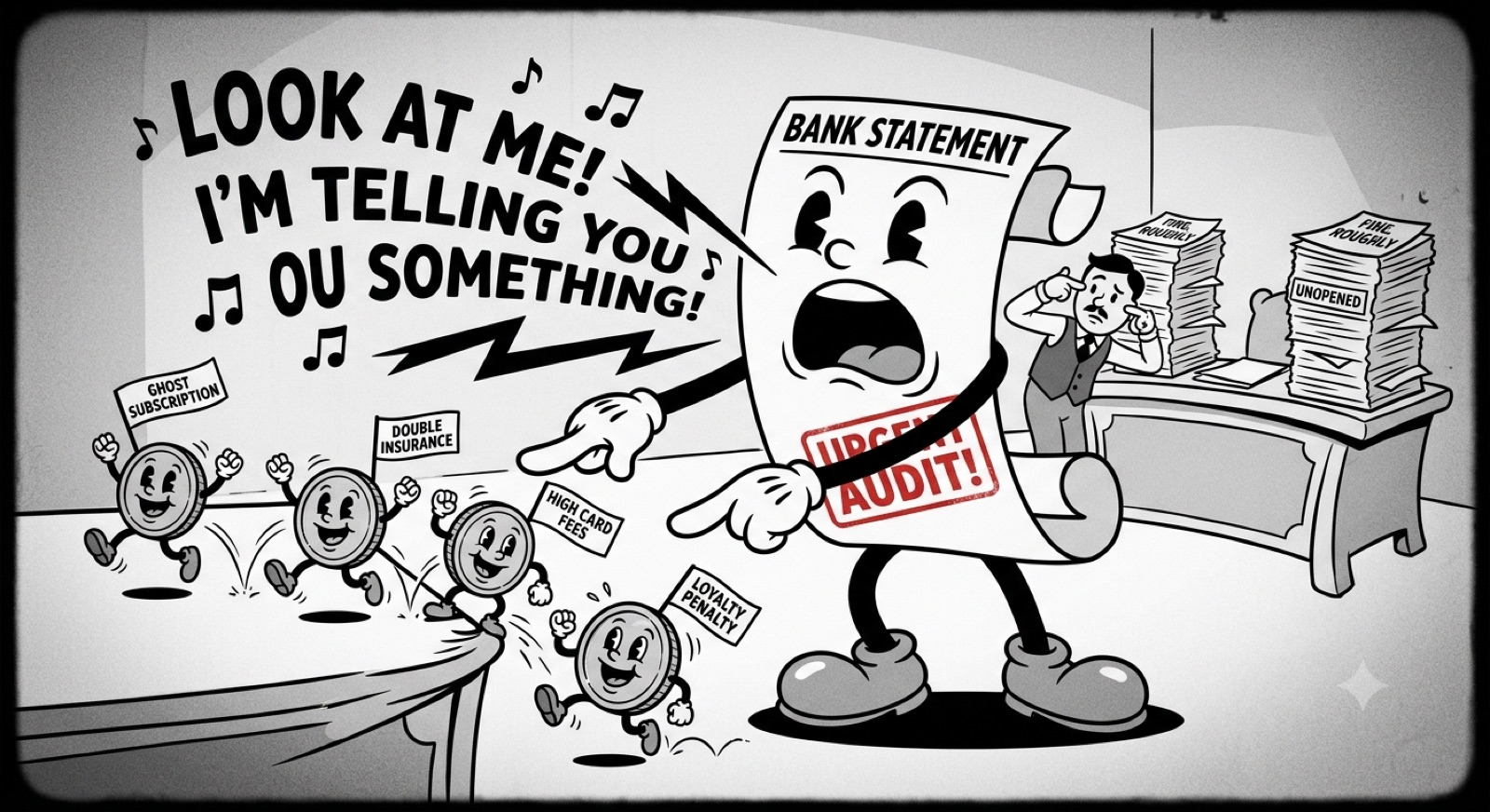
Here's the thing. You already have the data. It sits in your banking app right now, twelve months of it, every transaction logged and timestamped. Most business owners never open it as a full picture. They check the balance, wince, close the app, and carry on.
So let's open it properly. Not to budget. To find out what it's costing you to not look.
The idea
The Financial Prompt Library is a set of ten AI commands, each rebuilt for UK tax structure, UK products and UK regulation. This week's taster is Module 2. We call it /leak. You paste in a bank export, one prompt runs a forensic audit against it, and the output tells you where money is escaping without your permission.
No spreadsheet. No categorising two hundred transactions by hand at eleven at night. One prompt, one export, one report.
Below is a worked example. The numbers are composite, built from patterns we see across small business owners rather than any single real account, but the structure is exact. This is the report you'd get.
Meet the business
A one-person consultancy. Decent revenue, tight margins, the owner working sixty-hour weeks and telling themselves the spending side is "fine, roughly." Monthly business spend sits around £4,200. She'd never sat down and categorised a single month of it.
What the prompt found
Fifteen categories, one total.
The audit sorted every transaction: software, subscriptions, client tools, transport, insurance, food, the lot. Nothing new there. Any bookkeeper does this.
Here's where it stopped being ordinary.
Three subscriptions with no matching usage.
A project management tool nobody had opened in four months. A stock photo library replaced by a cheaper one eight months back, still billing on the old card. A webinar platform bought for one launch and never cancelled. Combined: £67 a month. £804 a year. Gone, for nothing.
A loyalty penalty on business insurance.
The policy auto-renewed at 34% above what a fresh quote returned for identical cover. This is the single most common leak we see, and the one people notice least, because the charge looks routine every time it lands.
Duplicate cover, hiding in plain sight.
A business bank account with a monthly fee that already included a benefit she'd separately paid for elsewhere. Two policies doing the work of one.
Card processing fees above the going rate.
A payment provider charging a blended rate meaningfully higher than a comparable provider for her transaction volume. Small on any single invoice. Not small across a year.
The report didn't stop at naming these. Each leak carried an annual figure next to it, not a monthly one. That's deliberate. £67 a month sounds like nothing. £804 a year buys a proper conference ticket, three months of a part-time hire's hours, or the first deposit on the tool she'd been putting off.
The recommendation
The prompt closed with three cuts, ranked by pounds recovered against effort required to make them. Cancel the two dead subscriptions today. Get one competing insurance quote this week. Call the payment provider and ask them to match a competitor's rate before switching, since that call alone often closes most of the gap.
Total recovered: roughly £2,100 a year. From spending she was already doing. Nothing new to sell, nothing new to build, no extra hours worked. Money that had simply stopped being noticed.
Why this works better than a budget app
A budgeting app tells you what you spent. It doesn't ask why, and it certainly doesn't flag that your stock photo subscription has been double-billing you since March. Software sorts. It doesn't audit.
The forensic frame is the difference. The prompt isn't told to summarise your spending. It's told to hunt for it, the way an accountant would if you'd hired one for an afternoon and asked them to find what's wrong.
A taster of what the prompt looks for
The full prompt is a page long and instructs the AI to work as a forensic accountant, categorising every transaction into fifteen UK-specific categories, and hunting for these signals:
- →Subscriptions with no matching usage
- →Duplicate cover across insurance policies or account features
- →Loyalty penalties on renewals (insurance, energy, broadband, card processing) where a switch or a call would lower the rate
- →Bank fees, packaged account fees, overdraft interest
- →Cash machine and foreign transaction charges
- →Takeaway and delivery spend against food shop spend
- →Contactless spend under £10, aggregated
Then it ranks three to five immediate cuts by pounds recovered per unit of effort, targeting a 10 to 20 per cent reduction without a lifestyle hit, and closes with total spend, total leak, percentage of income leaking, and the single largest recoverable amount.
This is one command out of ten
/leak is Module 2 of the Financial Prompt Library. The other nine sit alongside it: a zero-based budget builder, a debt clearance plan, an emergency fund calculator built against the actual UK safety net (SSP, redundancy pay, the Universal Credit five-week wait), a tax efficiency review that flags the Personal Allowance taper trap and the High Income Child Benefit Charge band, a retirement position model, a protection cover review, a net worth tracker, and the full financial health check that stitches all ten together.
Every prompt is UK-first. Not a US template with the currency swapped. Actual UK products (ISAs, LISAs, SIPPs, workplace pensions, salary sacrifice, Self Assessment), actual UK rules (Scottish tax bands where they differ, National Insurance thresholds, student loan plans by number), actual UK signposts (MoneyHelper, Pension Wise, the FCA Register).
Members get the full library inside the Premium Suite. Grab Module 2 as your free taster, run it on last month's numbers, and see what it finds.
Open the Financial Prompt Library →Get The Brief by email
One AI tool, one tip, one insight for small business owners. Free, every week.
Found this useful? Share it