5 Times You Should NOT Hire an AI Consultant (Written by an AI Consultancy)
It might sound strange coming from an AI and automation consultancy, but buying our services at the wrong time is a complete waste of your money. Here are the 5 exact scenarios where we'd tell you not to.

Donna Mitchell
Founder · Communications & Change Strategist
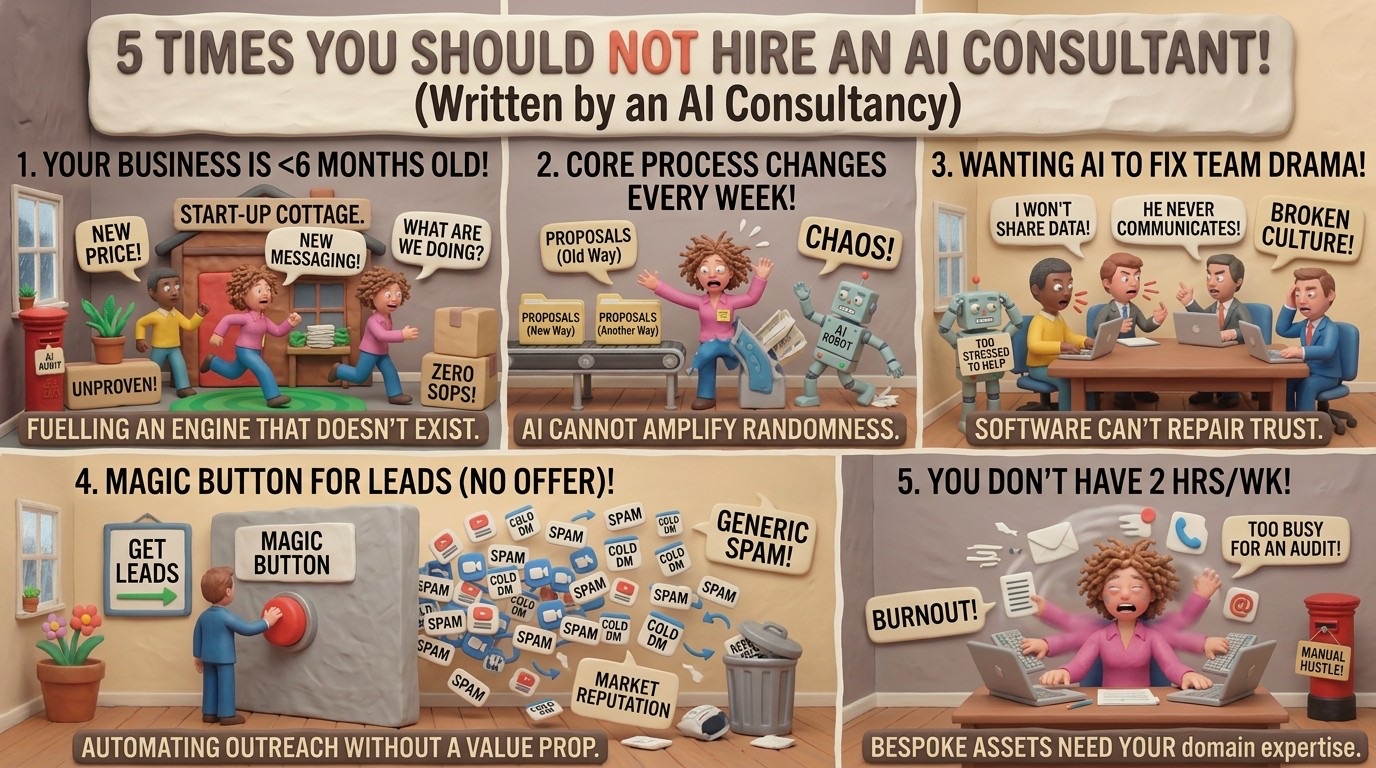
It might sound strange coming from an AI and automation consultancy, but here's a truth most agencies won't tell you: buying our services at the wrong time is a complete waste of your money.
In 2026, the hype around artificial intelligence is still loud. Every week, founders are told that if they aren't automating every corner of their business, they're falling behind. So they rush out, hire consultants, buy software, and expect instant operational magic.
Three months later, they're out thousands of pounds, frustrated, and convinced that "AI doesn't work for small businesses."
The technology does work, but it isn't a silver bullet. AI is an operational amplifier. Feed it a clear, validated, repeatable process and it amplifies your efficiency. Feed it chaos, uncertainty, or broken team dynamics, and it simply accelerates the mess.
Before you book a call with us, or any other consultancy, here are the 5 exact scenarios where spending money on an AI consultant is a waste of your capital.
1. Your business is less than 6 months old (or lacks product/market fit)
If you're in the early stages of your business, your focus should be on talking to customers, testing your offer, and finding out what people will actually pay for.
Automation is built for scale and repeatability. In your first six months, you shouldn't want a rigid, automated system, because your message, pricing, and deliverables are supposed to evolve rapidly based on real-world feedback.
Why AI fails here
You can't train an AI
Business Twinon your brand voice or standard operating procedures if those procedures change every time you sign a new client.
What to do instead
Do things manually. Write the proposals yourself. Handle the customer service directly. Sit with the friction until you know exactly what a winning client journey looks like. Only then should you hire someone to automate it.
2. Your core process changes every single week
You don't need a 6-month-old startup to suffer from this. We regularly speak with established UK agencies and service firms doing £500k+ a year where no two projects are delivered the same way. A founder winging every client onboarding, changing project management tools monthly, or letting every account manager invent their own workflow has a process hygiene problem, not a tech problem.
Why AI fails here
AI requires structured logic. If step 2 is sometimes an email, sometimes a WhatsApp message, sometimes a Loom video, and occasionally forgotten entirely, an integration engine like Make or Zapier will constantly break.
What to do instead
Pause the tech spend and run an internal process audit. Map your ideal customer journey on paper. Standardise your SOPs across the team first. Once you have a consistent, manual engine running, an AI consultant can digitise and accelerate it in a fraction of the time.
3. You want AI to "fix" a team member who refuses to communicate
We occasionally get calls from overstretched founders hoping an automated workflow or an AI assistant will bypass an uncooperative employee or a disengaged team.
AI can handle data flow, draft initial emails, summarise meetings, and organise files. It cannot repair broken company culture, instil accountability, or make someone care about their work.
Why AI fails here
Successful AI implementation requires team buy-in. If your staff feel anxious, threatened, or resistant to new systems, they'll simply ignore the new tools, find workarounds, or let automated leads sit cold in the CRM. You end up paying for software licences nobody logs into.
What to do instead
Address the human side of change management first. Set clear expectations, involve your team in identifying operational bottlenecks, and establish guardrails where AI is framed as a co-pilot that buys them back time, not a spy or a replacement.
4. You're looking for a "magic button" to get leads without a clear offer
"Can you build us an AI agent that automatically outreach-DMs 500 LinkedIn prospects a day and books sales calls?" We turn this request down immediately.
If your core offer isn't converting manually, automating your outreach won't bring in clients, it will only burn through your market reputation faster. AI can dramatically speed up lead qualification, instantly respond to inbound website enquiries, and tailor proposal documents, but it cannot fix a weak value proposition or a cold audience.
Why AI fails here
High-volume, generic automated outreach is recognised as spam by both algorithms and human prospects. It damages brand trust and yields abysmal conversion rates.
What to do instead
Refine your positioning, clarify your target market, and secure your first few flagship clients through high-touch, human-led outreach. Once you have an offer that resonates, use AI to capture, qualify, and nurture those inbound leads at speed.
5. You don't have 2 hours a week to review and approve the build
Building a custom AI context layer, one that genuinely understands your business, tone of voice, past client wins, and UK compliance guidelines, is a collaborative effort.
If a consultancy claims they can build a bespoke Business Twin for your company with zero input from you, they're selling you a template, not a custom asset. Any consultant promising a hands-off miracle is going to deliver a generic setup that sounds like everyone else's.
Why AI fails here
You are the domain expert. A consultant needs your feedback during scoping, testing, and refinement to make sure the system reflects how you actually run your business.
What to do instead
Wait to start an AI project until you, or an operational lead in your business, can commit roughly 2 hours a week during the implementation window. That small investment of founder time is what tends to be behind a system that keeps saving you hours for years, not just weeks.
The bottom line
At BrightMind Studio, we prefer long-term client success over quick software setups. We'd rather tell you "not yet" today than take your money for a project that won't deliver a clear, measurable return.
If your processes are chaotic, your offer is unproven, or your team isn't ready, save your budget. Fix the operational foundations first.
However, if you do have:
- →A proven service and validated offer
- →Consistent, repeatable administrative tasks eating up 10–20 hours of your week
- →A desire to scale capacity without adding expensive headcount, and
- →2 hours a week to collaborate on building a long-term asset
...then an AI implementation isn't a risk, it's one of the highest-ROI investments you can make in your business this year.
Ready for an honest look at your operations?
Take our free 3-minute AI Readiness Audit, or book a free 45-minute discovery call. If you're not ready for AI, we'll tell you exactly what to fix first, no sales pitch, just clarity.
Take the free AI Readiness Audit →Book your free discovery call →Frequently Asked Questions
When should I not hire an AI consultant?
Five common cases: your business is under 6 months old or hasn't found product/market fit yet, your core process changes weekly with no consistent workflow to automate, you're hoping AI will fix a team culture or communication problem, you want automated outreach without a converting offer behind it, or you can't commit roughly 2 hours a week to help build and refine the system.
How do I know if my business is ready for AI implementation?
You need a validated, repeatable process, not a perfect one, plus consistent administrative tasks worth automating and some founder or operational-lead time to collaborate on the build. Our free AI Readiness Audit scores this across five areas in about 3 minutes.
What should I fix before hiring an AI consultant?
Process consistency first. Map your core client journey on paper and standardise it across your team before spending on automation, an inconsistent manual process just gets automated into an inconsistent automated one. Team buy-in matters too: staff who feel threatened by new tools will quietly ignore them.
Can AI fix a difficult team member or broken company culture?
No. AI can handle data flow, draft communications, and organise information, but it can't instil accountability or repair trust between people. That needs direct management and change-management work first; automation on top of unresolved team issues usually just gets ignored or worked around.
Get The Brief by email
One AI tool, one tip, one insight for small business owners. Free, every week.
Found this useful? Share it