Bias in AI, and Where It Shows Up in Business
Your Hiring Filter Is the Riskiest AI You Own
Where AI bias comes from, the six business processes most exposed, and what UK law expects of you. Practical mitigation for small businesses, no legal jargon.
Last reviewed 04 Aug 2026

Carl Grant
BrightMind Studio
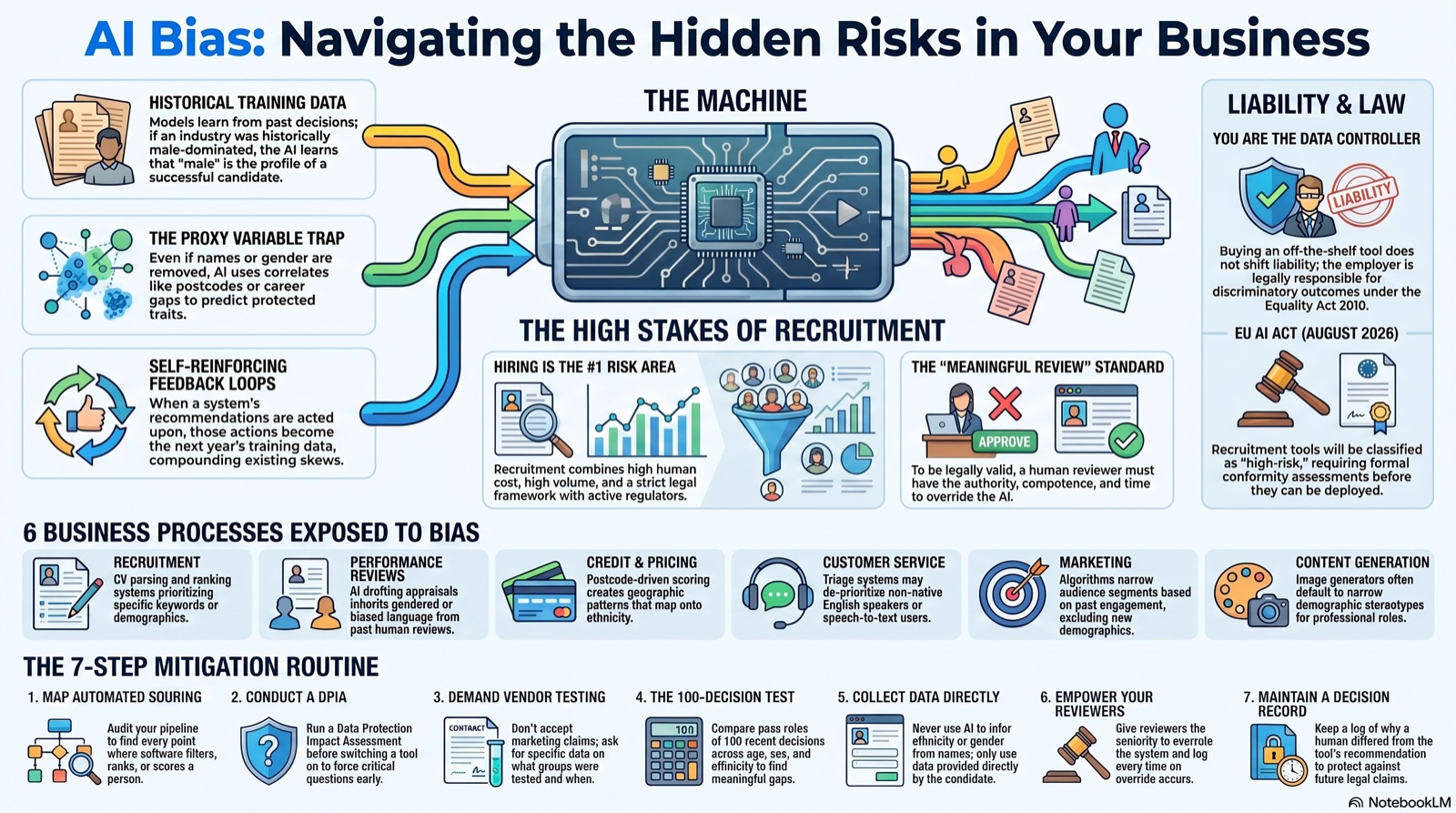
AI bias is the pattern of an AI system producing worse outcomes for one group of people than another, without a legitimate reason for the difference. It enters through the training data, through variables standing in for protected characteristics, and through feedback loops that reinforce past decisions. Of every AI system a small business runs, the one screening job applicants carries the most legal and human risk, because UK employment law holds you responsible for the outcome no matter who built the tool.
This post covers how bias gets in, the six business processes where it surfaces, and a mitigation routine that works for a team of five.
Three routes bias takes into a model
The training data.
A model learns from historical examples. Feed it a decade of hiring decisions from an industry where men held most of the senior roles, and it learns that the profile of a strong candidate looks male. It has not developed a view about gender. It has learned to reproduce a pattern, and the pattern was already there before anyone wrote a line of code.
Proxy variables.
Remove name, gender and ethnicity from the data and bias survives through correlated fields. Postcode correlates with ethnicity and income. Career gaps correlate with parenthood and disability. Which university someone attended correlates with class background. The model never sees the protected characteristic and predicts it anyway.
Feedback loops.
A system trained on your past decisions makes recommendations, you act on them, and those actions become next year's training data. Any skew in the starting point compounds rather than corrects. This is the quiet one, because the system appears to improve while narrowing.
Worth adding a fourth that gets less attention. Language models absorb the statistical texture of the internet, so they carry associations from a corpus nobody audited. Ask for a description of a nurse and a surgeon and watch which pronouns appear by default.
Why hiring sits at the top of the risk list
Three factors stack up in recruitment that rarely appear together elsewhere.
The decision affects a person's livelihood, so the human cost of a wrong answer is high. The volume is large enough that a small statistical skew produces a visible pattern across hundreds of applicants. And unlike most business processes, it sits inside a legal framework with an active regulator and a tribunal system behind it.
The UK evidence is not theoretical. The ICO audited AI recruitment providers between August 2023 and May 2024 and found tools that let employers filter out candidates holding particular protected characteristics, along with tools inferring gender and ethnicity from a candidate's name rather than asking. Some collected far more data than needed and kept it indefinitely to build candidate databases without those candidates knowing. The audit produced a substantial set of compliance recommendations.
Read the ICO's AI recruitment audit outcomes report →The regulator went further in March 2026, publishing a report drawing on evidence from more than 30 UK employers. Its central finding is the one worth sitting with: many employers did not recognise they were carrying out automated decision-making at all. They described their tools as decision support with a human making the final call, while the evidence showed tools making substantive decisions and human review amounting to rubber-stamping. A number of named organisations were written to and have committed to act.
Read the ICO's March 2026 report on automated decision-making in recruitment →The line that matters most
An Employment Tribunal does not accept "the algorithm produced the shortlist" as a defence to an indirect discrimination claim. The Equality Act 2010 sits alongside data protection law and applies to every tool you buy, whoever built it and wherever they are based.
Which means bias testing is your obligation as the employer, not a question you hand to your vendor. You are the data controller. Buying an off-the-shelf applicant tracking system with an AI screening feature does not move the liability to the software company.
Two other frameworks are worth knowing. UK GDPR rules on automated decision-making, as amended by the Data (Use and Access) Act 2025, set out what human involvement has to look like. And from August 2026 the EU AI Act classifies recruitment and candidate evaluation tools as high-risk, requiring conformity assessments before deployment. If you hire across both jurisdictions, passing one test does not guarantee passing the other.
What meaningful human review actually requires
The ICO sets a specific bar. The reviewer needs the authority, the discretion and the competence to change the outcome before it takes effect. They have to be capable of overriding the result, and in practice they need to sometimes do it.
Scanning an AI-generated shortlist and clicking approve does not clear that bar. Neither does a reviewer who lacks the seniority to overrule the system, or one given four minutes per candidate across 200 applications.
If nobody in your process has ever overridden the tool, you do not have human review. You have a human signature on an automated decision.
Six business processes where bias surfaces
Recruitment and shortlisting.
CV parsing, ranking, video interview scoring, and the keyword filters that predate AI but behave the same way. Highest exposure by a distance.
Performance review and promotion.
AI summarising review notes or drafting appraisals inherits the language patterns of past reviews. Research on human appraisals has long shown different vocabulary applied to men and women describing identical performance. A model trained on those notes reproduces the split.
Credit, pricing and risk decisions.
Any system scoring customers for payment terms, deposits or credit inherits whatever the historical data encoded. Postcode-driven pricing is the classic example, and it produces geographic patterns that map onto ethnicity.
Customer service routing and triage.
Systems prioritising or escalating queries score writing style. Non-native English speakers, older customers and people using speech-to-text get scored differently on urgency and sentiment, so their issues wait longer.
Marketing targeting and ad delivery.
Audience optimisation narrows toward whoever engaged before. Run it long enough on an unrepresentative starting audience and the algorithm quietly excludes segments you never chose to exclude.
Content and image generation.
Ask for images of a leadership team, a tradesperson or a customer and note who appears. Your marketing output starts to carry a demographic default nobody in the business chose.
A mitigation routine that fits a small business
You do not need a compliance department. You need seven habits.
Map where automated scoring happens.
Walk your recruitment pipeline stage by stage and mark every point where software scores, ranks or filters a person. Most owners find more than they expected, because ATS keyword filters and email tools have absorbed AI features quietly.
Run a Data Protection Impact Assessment before switching a tool on.
Before, not after. The ICO lists this first for a reason, and it forces the questions you would otherwise skip.
Ask the vendor for documented bias testing.
Not a marketing claim. Ask what was tested, against which groups, on what sample, when it was last repeated, and what the results were. A vendor unwilling to answer has told you something.
Test outcomes, not intentions.
Take 100 recent decisions and check the pass rate by group. Age band, sex, and ethnicity if you collect it separately for monitoring. A meaningful gap needs explaining. This is the single most useful thing on the list and almost nobody does it.
Collect monitoring data directly, never by inference.
The ICO found tools guessing ethnicity from names. Inferred characteristics are inaccurate enough that they fail at the job they were introduced to do, and processing them without a lawful basis creates a second problem on top of the first.
Give the reviewer real authority and real time.
Named person, seniority to overrule, and enough minutes per decision to form a view. Log overrides. A zero override rate is a finding, not a success.
Keep a decision record.
What the tool recommended, what the human decided, and why when they differ. If a claim arrives eighteen months later, the record is what you have.
The part small businesses get wrong
Owners assume this applies to companies hiring hundreds of people. The exposure is different at your size, not absent.
A business hiring four people a year has a small sample, which makes statistical patterns harder to spot and does nothing to reduce the harm to the individual affected. And the tools reaching small businesses are the off-the-shelf platforms shipping AI features by default, often switched on without an announcement. You inherit the vendor's design decisions and the regulator's expectations at the same time.
The reasonable position for a small team is not to avoid these tools. It is to use them for the parts of the process where a wrong answer costs little, and keep humans in charge of the parts where it costs someone a job.
Where to start this week
Open your applicant tracking system and find out which AI features are enabled. Then run the 100-decision outcome test on whatever process you already automate. Both take an afternoon, and between them they will tell you more about your exposure than any policy document.
Our AI Business Audit covers governance as one of its five areas and will show you where automated decisions are running in your business. The Academy glossary explains the terms in this post if any of them are new.
Take the free AI Business Audit →Browse the AI Glossary →General guidance, not legal advice. Take advice on your specific circumstances before making hiring or vendor decisions based on it. Last reviewed 04 Aug 2026 — the EU AI Act's high-risk obligations start in August 2026 and ICO guidance is still moving, so this page is due a review every three months through the first year.
Frequently Asked Questions
What is AI bias in simple terms?
AI bias is an AI system producing systematically worse outcomes for one group than another without a legitimate reason. It comes from historical patterns in training data, from variables that stand in for protected characteristics, and from feedback loops that reinforce past decisions rather than correcting them.
What are real examples of AI bias in business?
Recruitment tools that filter or rank candidates using protected characteristics or proxies for them, credit and pricing systems that produce geographic patterns mapping onto ethnicity, customer service triage that scores non-native English writing as lower priority, and image generation that returns a narrow demographic default for business roles.
Is my business legally responsible for a biased AI hiring tool?
Yes. In the UK you are the data controller and the employer. The Equality Act 2010 applies regardless of who built the software, and an Employment Tribunal does not accept the algorithm as a defence to an indirect discrimination claim. Bias testing is the employer's obligation, not the vendor's.
What did the ICO find about AI recruitment tools?
Its audit found tools allowing employers to filter out candidates with protected characteristics, tools inferring gender and ethnicity from names rather than asking, and excessive data collection retained indefinitely. A later report found many employers did not realise they were carrying out automated decision-making at all, with human review often amounting to rubber-stamping.
How do I test an AI tool for bias without a data team?
Take 100 recent decisions and compare pass rates across age bands, sex and ethnicity using separately collected monitoring data. Any meaningful gap needs an explanation. Ask your vendor for documented bias testing covering what was tested, on what sample, and when it was last repeated.
Does removing names and photos from applications fix AI bias?
No. Bias survives through correlated fields. Postcode, career gaps, university and hobbies all correlate with protected characteristics, so a model predicts them without ever seeing them. Blind screening helps with human bias and does little for algorithmic bias.
Found this useful? Share it